


Welcome back.
As leadership teams begin planning for 2027, much of the conversation will naturally turn to budgets, revenue targets, and next year’s initiatives.
I think it is worth spending some time on the strategy behind those numbers before the plan gets too far along.
A team can agree on a growth target without agreeing on how to achieve it. One leader may see a new market as the priority. Another may believe the better return will come from existing customers. Both can support the same revenue number while making very different assumptions about hiring, investment, and execution.
Q4 gives the team time to work through those differences before they become competing commitments in January.
Four questions can help:
Which assumptions in our plan need to be tested again?
Which opportunities deserve investment in 2027?
What should we stop, delay, or deprioritize?
What evidence or capabilities do we need before committing more resources?
The answers should give the team a clearer view of where the company will play, how it expects to win, and what it will take to follow through. That is a useful foundation for the budget and operating plan.
Poll
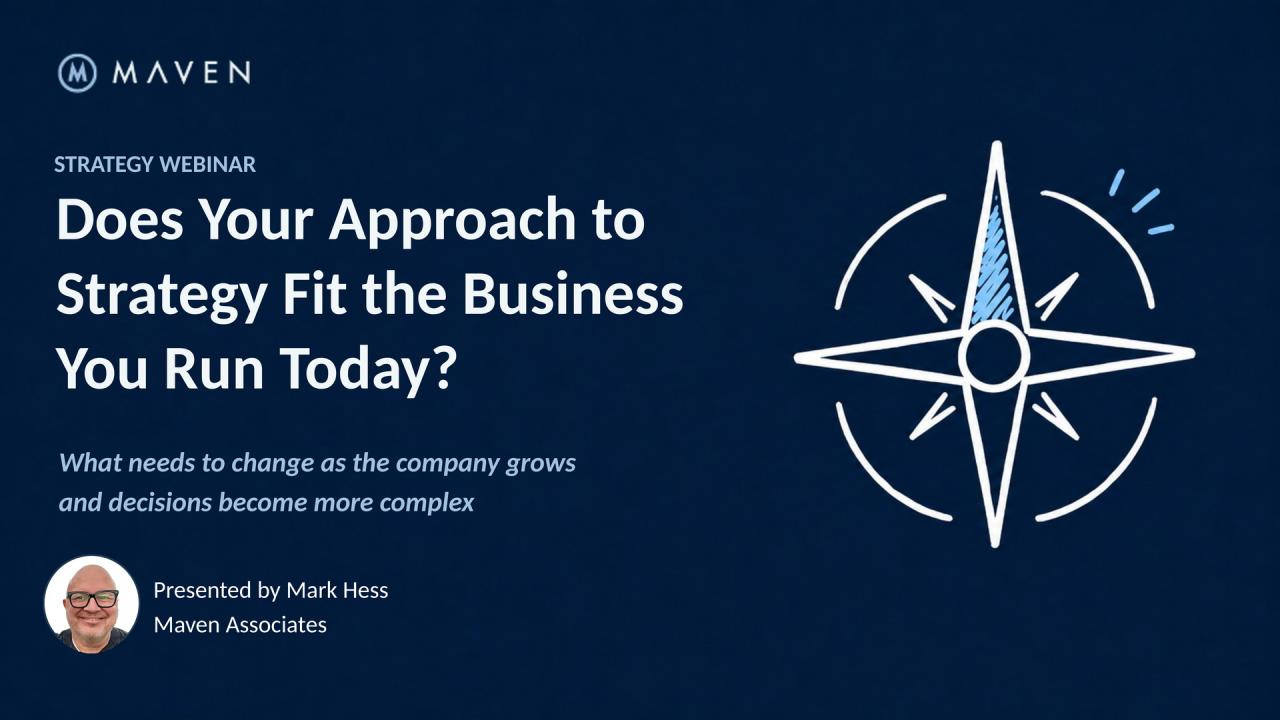
Join Me November 17: A Practical Strategy Webinar for 2027
On Tuesday, November 17 at noon Central, I’m hosting a live session on the strategic choices leadership teams should work through before finalizing their 2027 plans.
We’ll look at three connected questions:
Where will we play?
How will we win?
And what capabilities need to be in place?
I’ll share a simple way to compare your leadership team’s answers, spot where assumptions differ, and translate those choices into priorities for the year ahead.
If you’re a CEO or business leader working through next year’s plan, I’d welcome you to join us. Feel free to forward the invitation to a colleague who would find it useful.
Register for the November 17 webinar on LinkedIn — https://www.linkedin.com/events/7506791331416174593?viewAsMember=true
Maven Update
If you missed last month’s issue, The AI Value Gap and our TCGplayer case study are now available on the Maven website.
Both look at the choices behind technology investment, including what needs to change in the business for the technology to be useful.

Field Notes: Custom Truck One Source
This month, I am revisiting our work with Custom Truck One Source, which saw an opportunity to grow its aftermarket parts and service business.
The company had historically focused more heavily on truck sales and rentals. Maven helped assess the aftermarket part and service opportunity.
The work produced a business case, financial model, and phased implementation plan covering digital sales and scheduling, service-center capabilities, and staff development.
The engagement identified substantial potential upside. Realizing it would require investment and execution over time.
The useful lesson for planning is that identifying an attractive market is only part of the work. The strategy also needs to explain where to focus and what the company must build or change to compete there.

White Paper: Where AI Fits in Your Strategy
One question I would add to this year’s strategy discussion is: How could AI change the way we compete?
That could mean serving customers differently, removing an operating constraint, or responding to a competitor that can deliver the same work faster or at a lower cost.
The leadership team does not need to predict every development. It does need a point of view on which changes matter to the business and what it intends to do about them.
The AI Value Gap offers a practical way to sort the resulting opportunities: act where the business case and readiness are clear, test where a limited experiment can resolve uncertainty, and wait where the foundations or economics are not yet strong enough.
Those investments should compete for resources alongside the company’s other priorities, with a defined business problem and a measurable baseline.
Video Spotlight: Annual Planning and Strategy Facilitation
With planning season underway, I am revisiting a short video on how Maven approaches annual planning and strategy facilitation.
I talk through why an outside perspective and a clear structure for the discussion can help leadership teams examine assumptions and reach decisions they can act on.
How Maven Helps
Maven helps mid-market leadership teams evaluate growth opportunities, work through strategic tradeoffs, and build a practical plan for execution.
If your team is preparing for 2027 and would benefit from an outside perspective or a facilitator for the planning discussion, I’d be glad to compare notes.
Thanks for reading.
The new year will bring plenty of questions you cannot answer today. Q4 is a chance to resolve the ones already in front of your team, so January starts with clear priorities and fewer competing assumptions.
Onward,
Mark Hess
Founder, Maven Associates
Discussion Question
Which strategic decision does your leadership team need to resolve before January?
Share This Issue
If this note brought someone to mind, feel free to share it with them.
For Consultants
Know someone who thrives in mid-market strategy work?
Maven is always interested in connecting with experienced independent consultants, especially former Bain, McKinsey, and BCG consultants interested in focused work with mid-market companies.
Learn more or refer a colleague below.